In a lecture series given in 1841 “On Heroes, Hero-Worship, & the Heroic in History”, the Scottish essayist Thomas Carlyle presented his view of history that now is known as the great man theory. According to Carlyle, larger-than-life figures such as Luther and Napoleon decisively influenced historical events so much so that, “the history of the world is but the biography of great men”. In academic circles, the theory proved to be short-lived. A mere thirty years after Carlyle’s lectures, polymath Herbert Spencer published the now widely accepted position that humans are products of their societies and that historical research should focus on their underlying social conditions rather than individual men. In contrast to the stuffy study rooms of historians, the wider public still is fascinated by the notion of great men and women. Data scraped from the New York Times non-fiction bestseller list shows that the biography and memoir genre is nearly twice as popular with readers as the second placed politics and government category.

If the interest in great men and women of history is so present in the public mind, is our modern political system still able to produce such figures? With the roll-call data of the German Bundestag discussed in my last post, I’m setting out to find an objective measure of greatness in this proportional representation parliamentary system. In other words - which members of parliament (MPs) have the greatest influence on their colleagues?
In my last post, I used Cohen’s to uncover the voting relationships between MPs across the last six Bundestag legislatures. The is a measure of agreement beyond pure chance where each MP is simply treated as a count in the yes or no roll-call. It proved helpful to analyse party-wide relationships but did not account for the individual influence of MPs. To figure out if there are MPs that have an outsized effect on the voting behaviour of the Bundestag, we need to turn to Physics.
If an iron nail is heated above a certain temperature, it loses its magnetic properties. Letting it cool down will restore its magnetic permeability and in some cases even result in the formation of a permanent magnet. Physicists of the early 20th century sought to come up with a model that explained this transition from magnet to non-magnet and eventually landed on the Ising model. In this model, the iron material is represented by a grid of magnetic dipoles that either have north or south magnetic orientation. Each dipol is called a spin and may take either value +1 or -1. Spins interact with their neighbours and have lower energy if they agree with their neighbours and higher energy if they disagree. The following picture shows a two-dimenisonal grid of spins where the direction of the arrow indicates its value.
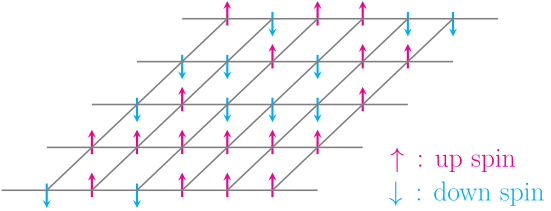
The transition of the nail under heat influence can now be expressed in terms of order. We observe magnetic permeability when the system is somewhat ordered. There are regions within the grid where spins have the same orientation and the overall energy of the system is therefore low. An arbitrary distribution of spins represents the non-magnetic state of disorder where energy is high. Heating up the nail increases its energy and disturbs the order of the spins. Formalising this behaviour via the level of energy in the Ising system yields
where the first term represents the sum over all unique pairs where is the coupling strength between each spin and the second term is an external field that acts on each spin.
The influence between MPs voting in the Bundestag can be represented by the same dynamics. Here, the spin is a yes or no vote and the coupling matrix describes how much individual MPs influence each other. Influence between MPs is defined as the degree to which the vote of one MP predicts the vote of another MP beyond party affiliation. The field is the individual MPs bias for a yes or no vote. We expect for example that a minister has a strong value on roll-calls triggered by the government as he likely votes with his government. The energy then is a proxy for surprising voting configurations: low energy states for the system are generated when the spins are locally aligned, meaning that MPs vote along their strongly coupled interactions. In Bundestag terms, we expect the coalition partners and the opposition blocs each voting together, resulting in a low energy state. Energy increases when MPs deviate from these patterns and vote against their expected pairings.
Given the roll-call data, we can now aim to recover the parameter of the model for each Bundestag period. Directly inferring the coupling matrix for each Bundestag period requires computing the joint distribution of each state
where is a normalising constant summing over all voting configurations. Recent parliaments exceed a size of MPs. As each MP can vote either yes or no when discounting for abstinations, looking at the complete state space of the parliament leads to possible outcomes per roll-call. This of course is computationally impossible - the Eddinton number, which measures the number of protons in the observable universe, is estimated to be . Instead of modelling the full joint distribution of states and then finding the most likely one, I use a pseudo-likelihood maximisation (PLM) method by Ravikumar, 2010 that models each MP’s conditional distribution separately. Instead of asking “What maximises the probability of the entire observed dataset?”, we consider an individual MP and question “Given how everyone else voted, what is the probability that MP voted yes?”. This is expressed in the conditional probability
which reads as the conditional probability of the vote of the MP given the vote all other MPs where is the sigmoid function squashing the value between and . Instead of a full joint distribution, we now can consider independent optimisation problems across all Bundestag roll-calls for one period. A nice way to visualise this voting influence is by plotting the mean coupling strength across all roll-calls for each MP over the correlation of said MP with the chamber majority. This plot is extracted from the Bundestag of 2017-2021

MPs placed on the right hand side of the plot tend to vote in agreement with the coalition as their parties usually are a member of it. The higher the MP is placed on the y-axis, the stronger is his influence on the vote of others. The parties top leaders - Fraktionsvorsitzende, Chancellor, and Vice-Chancellor - are highlighted. The chancellor, the most powerful person in the parliament and thus the most promising candidate for being a great man or woman of history, sits very near the bottom right corner of the graph. While agreement with the coalition is strong, the influence on the vote of other MPs seems to be weak. Coalition parties MPs that stray from perfect agreement with the coalition vote seem to exert higher influence on the parliament than the person leading the government.
At first, this is a surprising result. Surely the most well-known person in the parliament with the greatest legislative power - the magic word is “Richtlinienkompetenz”, a term that looks and sounds like the opposite of political power - should be the one to influence their peers more than a SPD backbencher rebelling against government policy?
To answer this question, we need to understand what the Ising model actually measures and how the German Bundestag operates. The coupling strength shows the influence of the voting behaviour of MP on others, beyond party affiliation. Government MPs vote in lockstep for roll-calls that are brought in by government and against roll-calls brought in by the opposition. The vote of high-ranking members of government is effectively predetermined via association. In the 2017 to 2021 period, the value of Angela Merkel is low because once her party allegiance is accounted for, knowing her vote adds no information about how her peers vote — and theirs adds none about hers. Every party MP knows how Merkel will vote in any given roll-call. The chancellor does not influence her peers by her vote but by pre-aligning the roll-call motion with her party and government. The power of government MPs lies not in their coupling strength to other MPs but in their actions before the vote happens. In the German parliamentary system, governmental power is exercised in committees (“Ausschüsse”) and meetings, not in the parliamentary debate itself.
This argument holds over all parliamentary periods in this data set, as this next chart shows. The values of chancellors never exceed the 5th percentile when compared against the whole chamber. The current Bundestag under Chancellor Merz is an exception caused by the limited number of roll-calls available - there simply has been too little opportunity for disagreement for the percentiles to become meaningful.

Interestingly, the distribution of coupling strength seems to be narrowing over time. Ignoring the current parliament, the Bundestag of 2021 to 2024 has a narrower distribution of absolute coupling strength values than the one of 2005 to 2009. That means MPs converge to a more homogenous level of coupling. While earlier parliaments had exceptionally strongly and weakly coupled MPs, the trend shows that we now mostly have moderately influential MPs in the Bundestag.
Where can we find the great man and woman of history in the Bundestag roll-call data then? The apparent answer is nowhere. As captured by the Ising model, Chancellors and powerful members of the government have no outsized effect on how the parliament votes. Party affiliation and government/opposition blocks dominate voting behaviour much more than any strong leader vote. Perhaps reassuringly, the power of German political leaders lies not in their ability to charm parliament on the day of the vote but in the countless preparatory sessions required to bring forward a legislative demand in the Bundestag. Processes and committees have a stronger influence over the fate of legislation than any single parliamentarian.
This seems to be a particularly German way to conduct politics. Carlyle surely had the parliament of the United Kingdom and the monarchies of old in mind when he conceived his idea of the great man. We imagine Churchill and Thatcher rousing and battling during Prime Minister’s Questions, swaying undecided MPs by sheer power of will and great oratory skill. Rightfully, we consider these two a great man and a great woman of history.
In the Bundestag, history is made not by heroes looming larger than the institutions they represent but by those very institutions themselves.